Sliding vs. Deciding: The Single Most Important Concept in Modern Premarital Practice
If you’re seeing engaged couples in your practice in 2026, the framework you most need at your fingertips is one developed two decades ago by Galena Rhoades, Scott Stanley, and Howard Markman at the University of Denver. The distinction between sliding and deciding is, in my view, the single most clinically powerful idea premarital therapists can offer the couples they work with — and it’s still missing from too many premarital protocols.
Here’s why it matters, what the research actually says, and how I work with it in session.
The Concept
Sliding describes what happens when couples drift into major commitments without explicitly choosing them. They start staying over a few nights a week, then most nights a week, then one of them lets the lease run out, and now they live together — without ever having a conversation about whether moving in was the right thing for them. They get engaged because their families started pressuring them. They book the wedding venue because that’s what comes next. Each transition is the path of least resistance rather than a decision.
Deciding, by contrast, describes couples who consciously choose each commitment milestone together. They have an explicit conversation about cohabitation. They have an explicit conversation about engagement. They have an explicit conversation about marriage timing. The transitions look the same on the outside, but the internal experience — and the long-term outcome — is fundamentally different.
What the Research Says
Stanley, Rhoades, and Markman’s 2006 paper in Family Relations introduced the framework formally and articulated what they called the inertia hypothesis: couples who slide into major commitments accumulate constraints (shared lease, shared furniture, shared social network, shared pet) before they accumulate dedication, and those constraints make it harder to leave a relationship that probably should end. The same constraints push some couples into marriages they would not have chosen if they’d had the conversation deliberately.
The cohabitation-effect literature is the clearest empirical example. Couples who cohabitate before marriage do not, on average, have worse marital outcomes — but couples who slid into cohabitation (rather than deciding to cohabitate after engagement) do show measurably higher divorce rates than couples who decided. The cohabitation itself isn’t the problem. The lack of explicit decision-making is.
Rhoades, Stanley, and Markman’s 2010 follow-up paper in Journal of Family Psychology on commitment trajectories deepened this further: dedication and constraint commitment operate independently, and couples whose constraints outpace their dedication are at meaningfully higher risk for marital instability.
For us as clinicians, the takeaway is that the question isn’t what the couple did. The question is how they got there.
How I Use It Clinically
In my premarital intake, I ask every couple a version of this question early: “How did you decide to get engaged?”
Couples who decided usually tell a clear story: “We had been talking about marriage for a while, and one Saturday we sat down and made a real decision together. The proposal came after.” Couples who slid often can’t quite articulate the moment of decision. They say things like “It just felt like the next step” or “Our families had been asking” or — most diagnostically — “I’m not really sure when we decided. We just sort of did.”
That distinction tells me which intervention the couple needs. With deciding couples, my job is to support and enrich what they already know how to do. With sliding couples, my job is to introduce explicit decision-making into the rest of their premarital trajectory before the wedding and into the early years of marriage afterward.
I use the same question across other transitions: How did you decide to move in together? How did you decide whose career takes priority? How did you decide to start trying for kids? Each one is a place where sliding can substitute for deciding and constraints can quietly accumulate.
Teaching the Framework to Couples
When I introduce the framework to couples, I draw a simple two-column comparison on the whiteboard:
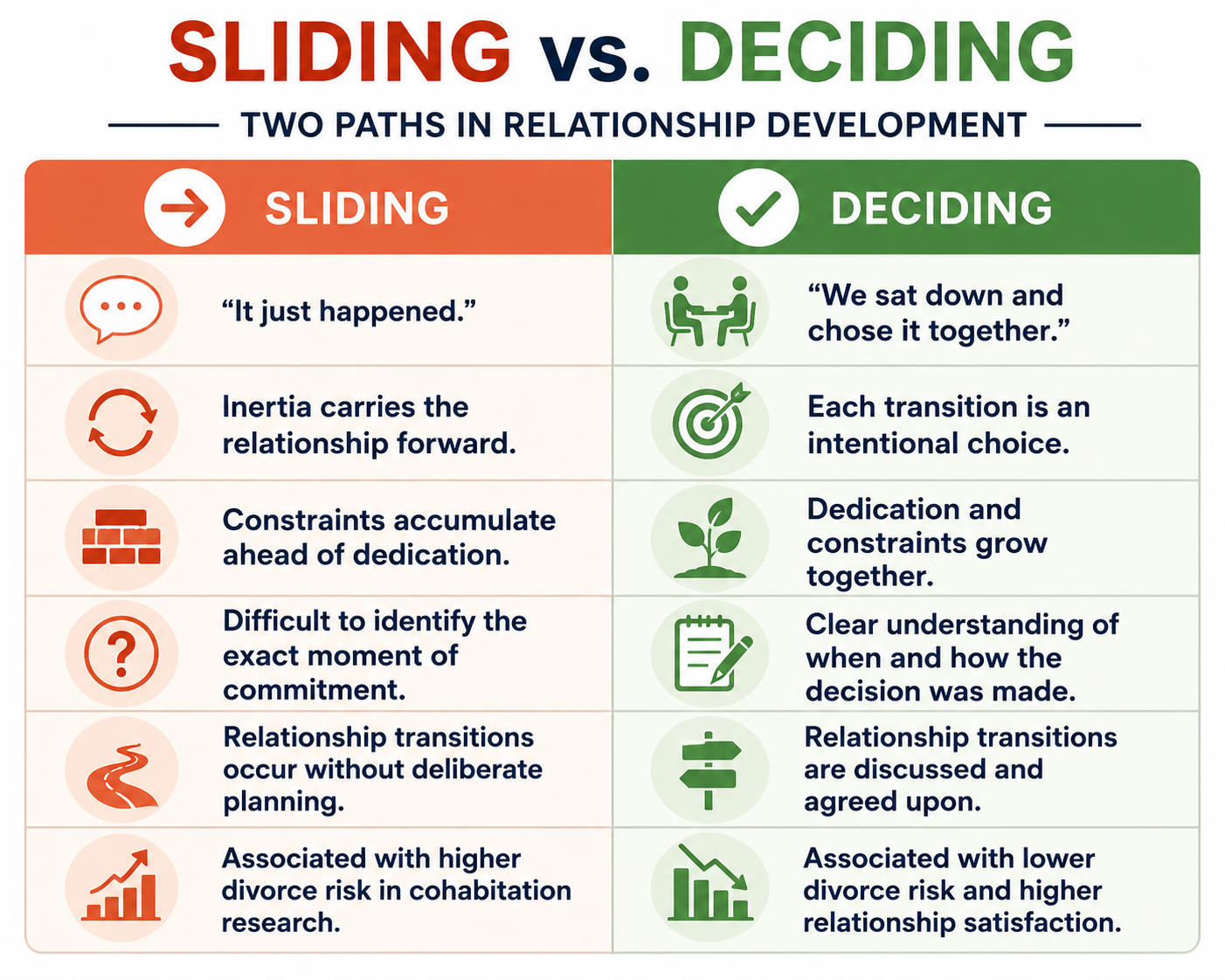
Once couples can see the distinction, I have them go back through their relationship and identify which transitions were slid and which were decided. The exercise alone often produces insight neither partner has had before.
I then introduce a simple practice for the rest of the marriage: every major transition gets an explicit decision. Money decisions. Career decisions. Parenting decisions. Geographic moves. Religious practice changes. Each one gets a conversation that ends with both partners articulating what they’re choosing and why. Deciding is a skill, and like all skills, it can be taught.
Where Sliding vs. Deciding Fits in a CE-Approved Premarital Protocol
If you’re building or refining a premarital protocol that meets state requirements (Florida, Tennessee, Georgia, Oklahoma, Minnesota, Texas), I’d argue that the sliding-vs-deciding framework deserves dedicated session time — not buried inside a broader communication module. The framework changes how couples narrate their entire history together, and that re-narration is itself therapeutic.
For clinicians integrating this framework into a premarital protocol, the work goes deeper than the question itself. The follow-up questions matter. The pacing matters. The interventions for sliding couples differ meaningfully from those for deciding couples, and getting that distinction right shapes whether a couple builds the deciding muscle or just leaves session feeling labeled. If you want the exact clinical question set I use to assess sliding in my own intakes, I'm sharing it free — see below.
Free for Clinicians: Sliding vs. Deciding Intake Question Bank
Over years of premarital work, I've refined a set of 15 clinical intake questions that surface sliding patterns quickly — across cohabitation, engagement, family pressure, and post-wedding milestones. They're the questions I'd want any premarital therapist to have on Day 1.
👉 [Download the free question bank →]
A Final Clinical Note
The most powerful moment I see in session is when one partner says, often with surprise, “We’ve never actually decided anything, have we?” That recognition — that they have been sliding, not deciding, for the entire relationship — is uncomfortable. It’s also where the work begins. Helping couples rebuild a decision-making muscle before the wedding is one of the most lasting interventions premarital counseling can offer.
The wedding is one day. The decisions are the rest of the marriage.
Where to Go Next
🎓 Clinicians: Explore the MyMHU CE Course Catalog → — CE-approved courses.
💍 Couples: Find a counselor trained in this framework on the Premarital Counseling Directory →.
📧 Stay in the loop: Join the MyMHU newsletter → for new clinical frameworks, CE course launches, and an upcoming structured premarital curriculum (yes — it's coming).
References
1. Stanley, S. M., Rhoades, G. K., & Markman, H. J. (2006). Sliding versus deciding: Inertia and the premarital cohabitation effect. Family Relations, 55(4), 499–509.
2. Rhoades, G. K., Stanley, S. M., & Markman, H. J. (2010). Should I stay or should I go? Predicting dating relationship stability from four aspects of commitment. Journal of Family Psychology, 24(5), 543–550.
3. Stanley, S. M., & Rhoades, G. K. (2009). Marriages at risk. In H. A. Moss, I. E. Sigel, & A. W. Siegel (Eds.), Parenting and the child’s world (pp. 317–338). Lawrence Erlbaum Associates.